The Time Period of the Iris
Given the empirical evidence suggesting a correspondence between the features of the iris and the traits of one's body and mind, it is natural corollary that the temporal aspect of one's life path is indicated along a time line. Although the iris is primarily a constitutional indicator it does change gradually and the changes are also likely to be related to one's life. At issue is the static correspondence between an aspect of the iris and the temporal aspect of one's life experience.
The most intuitive mapping is that the annular topology of the iris corresponds, like the face of a clock to the time line of one's life, with sectoral subdivisions pertaining to consecutive time periods. Given the possibility of such a correspondence mapping, what is the most likely scaling in terms of time interval per full circle (360 degrees)?
The commonly proposed scale is 60 years, which is a convenient choice because it is easily divisible by 2, 3, 4, 5, 6, 10, 12, 15, and 30. But there may be other valid period scales. Even if the 60-year correlation is supported by empirical data, it is a good idea to check for correlation at 120 (120=1*2*3*4*5) or 360 divisions since there may be harmonics and fractal-like pattern recurrence across different scales. Other harmonic patterns may be found at the other integral subdivisions of 60 (2, 3, 4, 5, 6, 10, 12, 15, and 30).
360 is a numerologically convenience, but conceivably, the annular period of the iris could be at 365.25, corresponding to the cycle of Earth's trip around the sun. Whether the individual 1/365.25 sectors represent days, years, or 1/6 years would be a separate issue.
The arithmetic convenience and versatility of the number 60 is only a consideration within the context of the base 10 number systems. In a base 2 model, the time period assignments are more likely to be at a power of 2, such as 32, 64, 128, ... A case can be made that the base 2 model is more fundamental than the base 10. The true dominant correlation could conceivably be 64 years.
In fact, Denny Johnson has found the 64-year interval most appropriate for modeling life state transition, as the sum of four 16-year intervals, each spanning 90 degrees or 1/4 of the full circle. Use of a 64-year cycle (26) facilitates the mapping of the iris circle to a binary tree such as one's ancestral lineage, or to a sequence of binary phase transitions at intervals of 4. This numbering scale has a lot of benefits, both utilitarian and aesthetic.
Divisibiliti may not be the only consideration. A base-free model would be based on the irrational number Pi for a scalar metric.
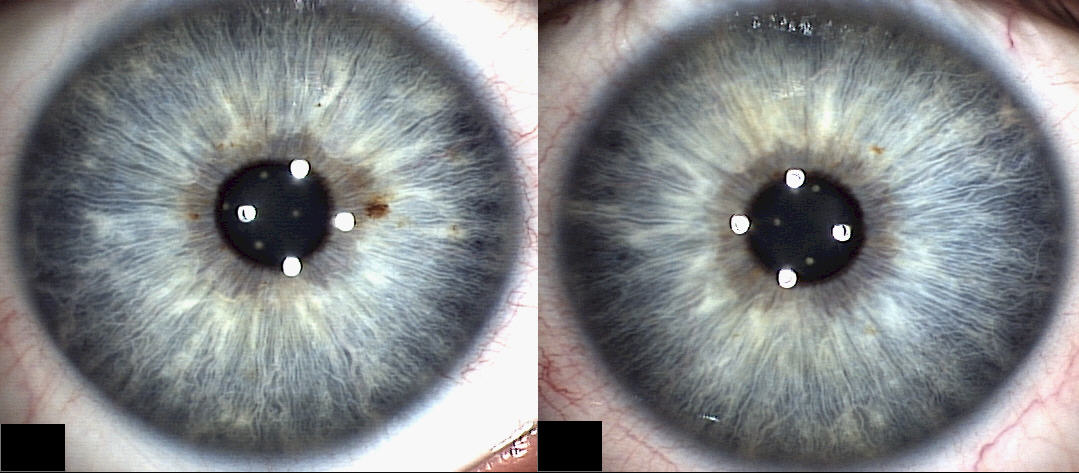
The number Pi is 3.14. 2 x Pi = 6.28318.... For a circle with a radius of 1.0 the circumference is 6.28. If the time scale is 6.28 years per iris cycle (period), one would expect patterns to recur every 6.28 years. For example my iris pattern ( http://www.milesresearch.com/iris/images/jm2up970918.jpg ) shows a distinct color spot at 3:00 in the right eye (75% around the circle Counter-Clockwise) . If the iris period is 60 years, then the marking signifies a situation at age 45 or 46. If the iris period is 6.28, the first correlation would be at age 6.28 x 0.75 = 4.71, the second correlation would be 4.71 + 6.28 = 10.99, the third correlation at 10.99 + 6.28 = 17.27, etc. This is just an idea and I have not tested it out. It is based on the idea that although 60 is the most convenient number for dividing the circle, it is based on our base 10 number system which is NOT universal. 365.25 is dimensionless but earth-specific. Pi (3.14159) however IS universal AND dimensionless.
For models of earth-related circumstantial factors or situational predisposition, the annual scalar for the annular topographic aspect is most likely a good choice, worth testing for anyway. One test would be between the 360-day correlation and the 365.25-day correlation. With this time scale every year is represented by a trip around the iris. Certain harmonic patterns are to be expected at integral multiples of the base frequency.
For models of soul destiny and life-transcendant experience, the scalar based on pi may be more relevant and useful.
Return to Miles Research Links